
January offsites: the white elephant in the room.
Organisations of all shapes and flavours will each spend tens of thousands on their January (or February) team offsites, more when you account for the opportunity cost. Sure, they'll return with flip charts dripping in post-its and photographs of whiteboards jam-packed with action items, maybe even a healthy dose of warm-fuzzies, and there may even be the odd hangover. But three weeks later nothing will have changed. This is what the research, and the lived experience of many, tells us. I'm not suggesting you cancel yours, rather I'm suggesting you have a wee think about it's purpose and the value you might be leaving on the table.
LEADERSHIPSTRATEGYEXECUTION
The January Trap
January and February are when New Zealand leadership teams gather. The Christmas break is over. People return tanned and rested. The calendar year has reset.
Here is the trap: you feel like you are starting fresh when you are actually mid-stream. Once should never
You're six months into the financial year. Your board approved the strategy and budgets back in June or July. Your team set OKRs, or whatever terminology is in vogue this year, and the strategy was locked in. But, the calendar seduces you into thinking you need a new beginning.
You do not. You need to check whether you are delivering on the solemn promises you made six months ago.
The long summer break creates psychological distance from those commitments. Leaders forget what they promised, and teams forget what they agreed to deliver (particularly where delivery has not been forthcoming). The offsite becomes a fun way to avoid accountability for the first half by generating excitement about a "fresh start" for the second half. New initiatives pile on top of unexecuted old initiatives, like new plaster board over rotting joists.
This is an execution problem all too often misdiagnosed as a strategy problem. And recognising the difference changes everything about how you should spend your offsite.
The Own Goal
In his book The 8th Habit, Stephen Covey translated a Harris Poll of 23,000 employees into an image that should haunt every leader, and that reminds me of a team I played for in the sixth form.
If your organisation were a soccer (football) team, only four of eleven players would know which goal was theirs. Only two would care. Only two would know their position. And all but two would be competing against their own teammates rather than the opposition.
The underlying numbers are alarming. Only thirty-seven percent of employees clearly understood what their organisation was trying to achieve. Only twenty percent were enthusiastic about their team's goals. Only fifteen percent felt their organisation enabled them to execute. And only ten percent believed anyone was held accountable for results.
Picture that soccer team. Four players kicking toward the right goal. Two who actually want to win. Nine who might as well be playing for the other side. This is not a team that needs a new game plan at halftime. This is a team that needs to understand the game plan they already have.
According to Harvard Business Review, companies deliver only sixty-three percent of the financial performance they promise in their strategic plans. Most executives blame poor 'strategic planning' (I'm confused, is it strategy or planning? A topic for another day). But the Covey data strongly points to a different explanation: the strategy is not the problem. The problem is that nobody understands it, believes in it, or is held accountable for executing it.
Your January offsite, unless you approach it differently, is about to make this worse by adding yet another layer of strategy that nobody will understand, believe in, or execute.
The Sugar Rush for Grown-Ups
Think of a children's birthday party. The kids arrive fizzing, they stuff themselves with cake and sweets, energy and decibels spike. They run around in a frenzy of activity until... the dreaded yet entirely predictable crash. By pickup time, they are tired, irritable, and you are left to pick up the pieces.
Your offsite works the same way.
Day one, energy is high. People are out of the office and away from their inboxes. They're sharing holiday stories, interspersed with the fresh new business thinking of the guru du jour they half listened to on the DOAC podcast ("or was it Rogan?"). They're thinking big thoughts. Day two, a fresh batch of commitments are enthusiastically made.
This was the best offsite ever.
Then comes the crash.
People return to overflowing inboxes and the urgent drowns the important. Old habits reassert themselves as we revert to type when under stress. The action items gather digital dust in shared drives that nobody opens. Take a moment right now: find the outputs from your last offsite and check when anyone last opened them, let alone acted on them.
Trust decays alongside momentum. The bonds formed over shared meals and team activities start weakening the moment everyone returns to their separate corners. Self-interest re-takes the wheel. The "us versus them" mentality returns. The organisation reverts to its prior state, just as vinaigrette separates back into oil and vinegar when the stirring stops (get it? BBQs, salads, vinaigrette).
Practitioners have given this pattern a name: the three-week wall. Teams walk away inspired, then fall straight back into old habits by Monday. Commitments fade to black, lessons from the inspirational guest speaker dissipate. By week three, the offsite might as well never have happened. What the...? These aren't bad or dishonest people.
The psychologist Hermann Ebbinghaus mapped the underlying biology in the 1880s. Without reinforcement, memory decays rapidly: half within hours, seventy percent within a day, ninety percent within a week. The brilliant insight from day two of your offsite? Half-forgotten by dinner.
The only reliable counter to this decay is repetition. There is a reason religions hold weekly services rather than annual conferences and athletes train daily rather than quarterly. Repetition is how humans learn and remember and commit. Yet too many organisations treat strategy as annual pronouncement, then wonder why nothing sticks.
The sugar rush feels good in the moment. But it leaves your organisation no healthier than before, and considerably poorer.
The Novelty Problem
Most offsites are designed to produce novelty. New visions, new strategies, and new initiatives.
But look again at the data. Sixty-three percent of your people do not understand your current strategy. Eighty percent do not trust the organisation to deliver on commitments. Ninety percent do not believe anyone is held accountable.
Under these conditions, a new strategy is worse than useless. It adds confusion to an already confused situation. The new strategy will be no better understood than the old one, will generate no more trust, and will be just as poorly executed.
Novelty, in this scenario, is a bug, not a feature.
What your organisation actually needs is much simpler. It needs to be reminded of what it had committed to. It needs to refresh its understanding of goals that have been lost in the noise of daily operations, and it needs to be challenged on whether it is actually doing what it set out to do.
This is not exciting, it doesn't generate the feeling of bold new direction that many executives crave. But it addresses the real problem rather than an imaginary one, and by addressing real problems you can set yourself up for a kick-arse second half.
The Rhetoric / Reality Gap
When ninety percent of employees believe that results do not matter, that failure carries no consequence, that commitments can be made and broken without anyone noticing, something has gone deeply wrong at the level of organisational character.
Accountability is not a system or process to be rolled out. It is how leaders and doers behave when neither is watching the other. It is built through hundreds of small moments that accumulate into culture, the same way trust is built in any relationship: promise by promise, kept or broken.
When a leader says they will do something and does it, accountability exists. When they don't, and nobody mentions the gap, accountability takes a hit. Do this enough times and accountability is dead entirely, replaced by a culture where words and actions have parted company.
The people on the front line of delivery remember what was promised even when leaders forget. They notice the gap between rhetoric and reality. Each time that gap goes unacknowledged, trust erodes further. It's not fair to brand the eighty percent who do not trust their organisation as cynics. They have learned that distrust through lived experience.
The biggest obstacle to your offsite delivering results is that your people have seen this movie before, and they know how it ends.
Changing that story requires doing something different.
How to Deliver a Killer Second Half
The good news: an offsite that produces lasting change is no more complicated than the standard retreat. It is simpler. It asks different questions. It measures success differently. And it treats the event not as a reinvention but as a reckoning that clears the path for focused execution.
Diagnose before you prescribe. Do not assume your people understand the strategy. Test it. Ask them to explain priorities in their own words. Ask what trade-offs they would make if forced to choose. Ask how their daily work connects to organisational goals. You will discover that whatever clarity exists at the top has not reached the middle or the front lines. This diagnosis is uncomfortable. It is also the foundation for everything else.
Subtract rather than add. Most organisations suffer from initiative overload. Too many priorities means no priorities. Everyone is spread thin across dozens of projects, and none receives sufficient attention. A leadership team that returns from an offsite with fewer goals, goals that clearly connect to the existing strategy, has done something genuinely valuable. The discipline of choosing what not to do is harder than generating new ideas. It is also what separates great execution from mediocre execution.
Refresh rather than reinvent. The problem is rarely that you lack a strategy. The problem is that the strategy you have is neither understood nor executed. Spend the offsite reinforcing what exists rather than generating what does not. Remind people why the current direction was chosen. Challenge whether the organisation is actually pursuing it. This frees your team to focus on delivery rather than constantly pivoting to the next new thing.
Design for action, not inspiration. Every decision should connect to a specific mechanism for follow-through. Who will do what, by when? What does done look like? How will anyone know whether it happened? These mundane questions determine whether the offsite matters three weeks later. If you cannot answer them for each commitment made, that commitment is already hollow.
Schedule the follow-up before you leave. Block ninety minutes, three weeks out, for the team to review progress on commitments made. The meeting appears in calendars before anyone leaves the venue. It is not optional. It is not a placeholder. This simple mechanism creates accountability by making the future review visible in the present moment of commitment. Knowing the reckoning is coming changes how people commit.
Name names. Not "we should improve retention" but "Sarah will present a retention analysis at the March board meeting." The named individual. The specific deliverable. The concrete date. These details transform vague intentions into actual obligations. They also reveal, through the act of naming names, whether the organisation truly has the capacity and will to execute what it has decided.
Do these things and you return from the offsite with something rare: genuine clarity about what matters, genuine commitment to deliver it, and a genuine mechanism to hold each other accountable. The second half becomes about execution, not distraction.
Set Up for Success
If you are planning a January or February offsite, the goal is simple: ensure that the return justifies the investment. That means resisting the calendar-year psychology and recognising that you are six months into a twelve-month cycle. Your job is to ask why the initiatives launched in June and July have not delivered results, and to clear the obstacles so the second half can succeed. It is not to launch a fresh bunch of new initiatives.
Before the offsite begins, answer three questions:
First, is your current strategy clear to those who must execute it? Not clear to you. Clear to them. Test it.
Second, is the strategy being executed? Not discussed. Not reported on. Actually done. Where there are gaps between stated priorities and real-world behaviour, those gaps need to be understood and closed.
Third, what must be true for the offsite's conclusions to matter in three weeks? What will remind people of commitments made? What will hold them accountable? What will prevent the urgent from drowning the important, as it always does?
If you cannot answer these questions, the offsite is already destined to fail. You will have a fun couple of days, but three weeks later you will have nothing to show for it except photographs of whiteboards that nobody will ever look at again.
But if you can answer them, you have the foundation for something different: an offsite that actually changes how your organisation operates, that builds trust rather than eroding it, and that sets your team up to deliver on the commitments you have already made.
You Have the Power
George Orwell observed that political language gives an appearance of solidity to pure wind. Corporate language serves the same function. It generates the illusion of action while enabling inaction. It allows people to believe they have done something when they have merely talked about doing something.
The annual offsite, as typically practiced, is wind. It sounds impressive. It costs real money. It produces documents and photographs and warm feelings. And three weeks later, nothing has changed.
This does not have to be your story. An offsite could be genuinely useful if it asked the right questions. "do our people understand the direction we already chose?", "are our current initiatives being executed?", "do our people believe in our vision, and if not, why not?".
These questions require confronting uncomfortable truths about the gap between what leaders say and what organisations do. They may reveal that the problem lies not in strategy but in leadership itself.
But asking hard questions is what the best leaders do. And answering them honestly is the only path to an organisation where more than thirty-seven percent of people understand what they are trying to achieve.
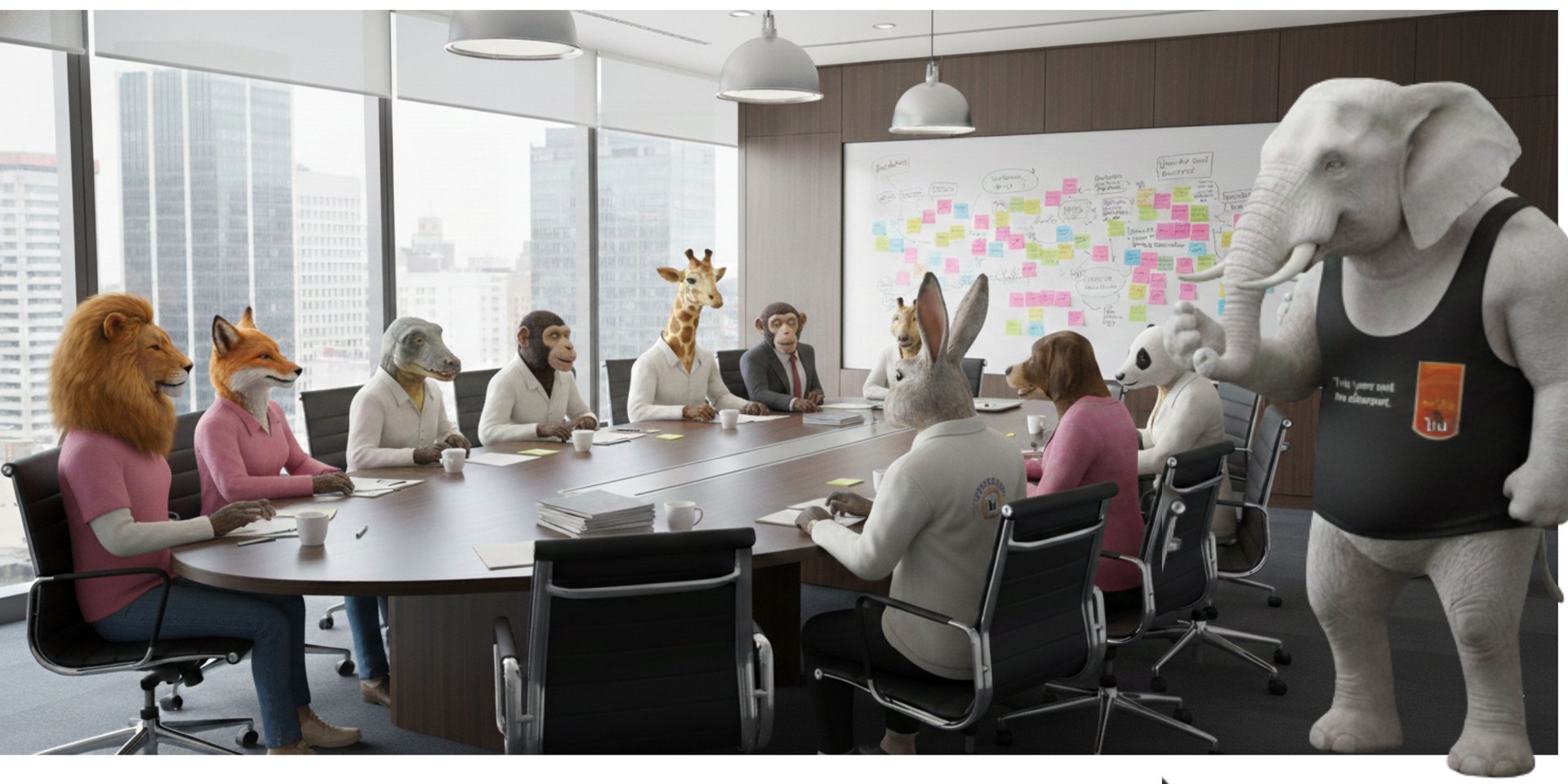
Image credit: Google Gemini prompted by the author. Elephant's singlet graphic "This year will be different" is a take on Tui Breweries' iconic "Yeah right" billboard campaign.
Clarity builds Confidence drives Momentum.
© 2026. All rights reserved.
Contact
Email: contact@reqlarity.co
Phone: +64 (0)27 498-1394
Terms & Conditions